

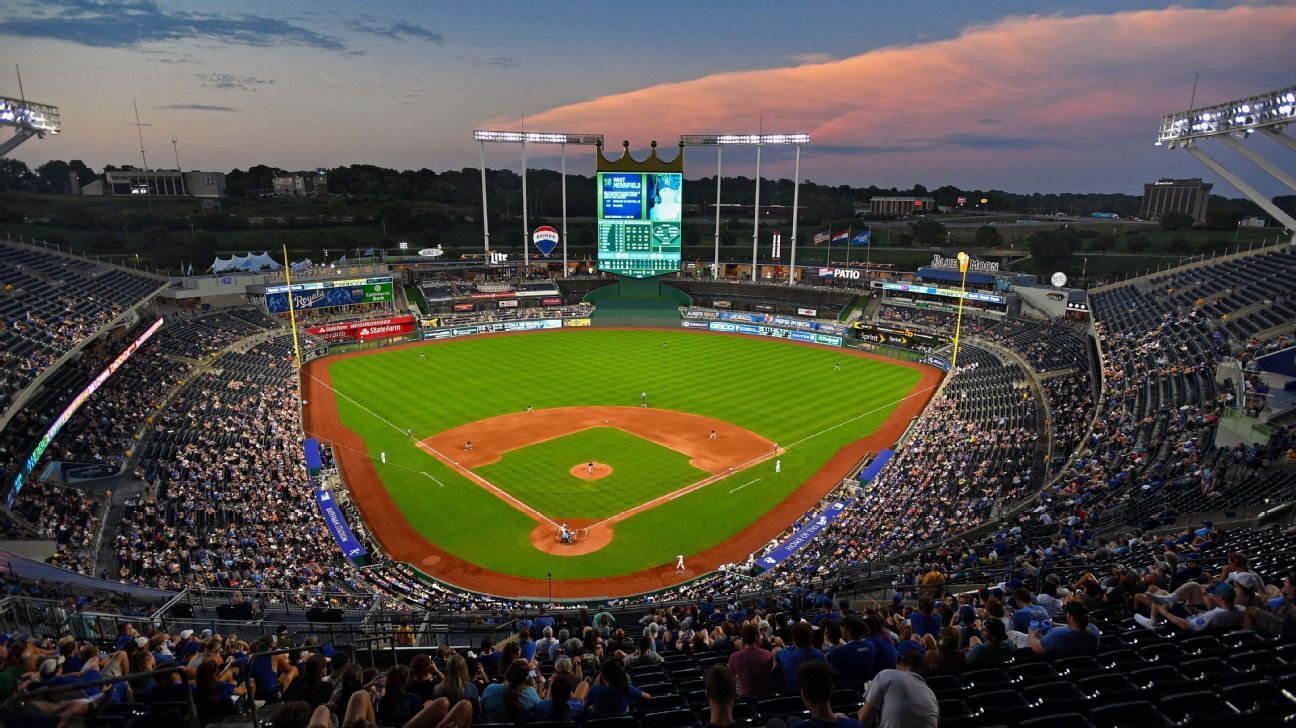
The Kansas City Royals are set to announce a major overhaul of their home stadium, Kauffman Stadium, with the majority of the outfield fence being moved in by 10 feet. This drastic change aims to transform the notoriously difficult stadium for home run hitting into a more neutral environment, one that will play to the team's advantage. According to sources, the Royals' front office has been discussing potential changes to the stadium's dimensions for years, and the decision to move the fences in is the result of a thorough analysis by the team's analytics department.
Neutralizing the Playing Field
The Royals' general manager, J.J. Picollo, emphasized the team's desire to create a neutral ballpark where a well-hit ball will result in a home run. "We want a neutral ballpark where if you hit a ball well, it should be a home run," Picollo said in an interview. "The second they start feeling like they can't get the ball out of the ballpark, they start changing their swing. I watched it for years and years and years, and I just felt like this is the time to try to push it and see if everything we felt for however many years is accurate." The goal is to create an environment where hitters can focus on their natural swing, without feeling pressured to adjust their approach due to the stadium's dimensions.
The changes to the outfield fence will be significant, with the power alleys being shortened from 389 feet to 379 feet. The fences will continue to taper in, reducing in length by 9 to 10 feet, almost all the way to the corners, where the 330-foot foul poles will remain. The height of the fence will also be reduced from 10 feet to 8½ feet. These changes are designed to create a more balanced playing field, one that will allow the Royals to compete more effectively with other teams in the league.
The distinct suppression of home runs at Kauffman Stadium has been a concern for the Royals, as hitters have been forced to adjust their approach on the road, consciously or subconsciously. By altering the dimensions, the team hopes to create a more neutral environment that will aid in their efforts to build a perennial playoff contender.
History of Modifications
Kauffman Stadium has undergone modifications in the past, with the fences being moved in 10 feet between 1995 and 2003. During this period, the stadium played as a slightly above-average home run park. However, when the Royals returned to the original dimensions in 2004, the stadium once again became notorious for its difficulty in hitting home runs. The Royals have seen numerous balls die on the warning track over the past two decades, prompting Picollo to finally approach owner John Sherman and request permission to conduct a study on the effects of a potential modification.
Data-Driven Decision
The decision to modify the outfield fence was driven by a thorough analysis of data, conducted by the Royals' vice president of research and development, Dr. Daniel Mack. Mack, who has a Ph.D. in computer science and a master's degree with a concentration in machine learning, was tasked with considering all the factors and making a recommendation. The study, which began in early May, involved applying a run value to every fly ball at Kauffman Stadium, with the goal of finding fence distances and heights that would result in a near-league-average run value on fly balls.
By moving the outfield fence in, the Royals hope to create a more neutral environment that will allow their hitters to focus on their natural swing, without feeling pressured to adjust their approach due to the stadium's dimensions. The changes are expected to have a significant impact on the team's performance, and fans can expect to see a more exciting brand of baseball at Kauffman Stadium in the future.
The Royals' decision to modify the outfield fence is a testament to the team's commitment to using data and analytics to drive decision-making. By leveraging advanced data and machine learning techniques, the team is able to make informed decisions that will ultimately benefit the organization and its fans. As the team looks to build a perennial playoff contender, the changes to Kauffman Stadium are an important step in the right direction.
Original: ESPN
Image: ESPN
Written by Npsports

